Make an invisible load visible — and control it.
Heatr understands how much flexibility each load really has, then decides which loads should respond, and how.
Know more than ON or OFF.
Simply knowing whether an element is ON or OFF is not enough. The stored energy tells Heatr how far heating can move while keeping adequate hot water available.
Identical signals. Nothing about how much each load could move.
Plenty of useful stored energy. Heating can move a long way.
Little stored energy. Heating should continue.
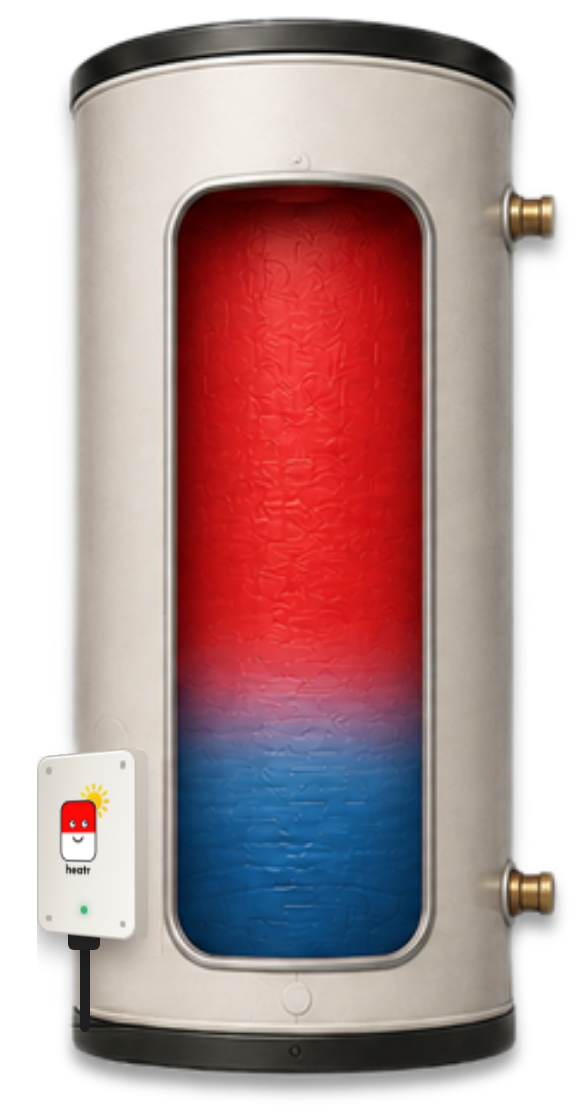 01 · Physical flexible load
Physical load
An electrical load with stored heat inside. A Heatr controller retrofits to an existing cylinder.
- 02 · Digitise
Digital twin
Replicate the hot-water cylinder in the cloud, making it visible and controllable.
- 03 · Understand
State of Charge
How much useful stored energy is available, and therefore how far heating can move.
Know what can move.
Heatr ranks and prioritises available loads. A highly charged cylinder may be a good candidate to defer heating; a depleted cylinder should not be treated the same way.
Not every load should respond.
High stored energy
can wait longer
- 94%Defer
- 86%Defer
- 77%Defer
- 66%Keep heating
Hot water needed soon
Some available flexibility
can pause temporarily
- 55%Pause
- 44%Pause
Low stored energy
keep heating
- 31%Keep heating
- 18%Keep heating
Decide. Then control.
Combine available flexibility with electricity price, network requirements, voltage, renewable availability and external flexibility requests or APIs.
- Electricity price
- Network requirements
- Voltage
- Renewable availability
- External requests / APIs
 Heatr decides
- The signals
- The State of Charge of every load
- The requirements of each asset and household
→ Which loads should respond, and how.
- Pre-heat
- Store energy ahead of need
- Pause
- Temporarily hold heating, then resume
- Shift
- Move heating to a better time
- Stagger
- Spread starts and restarts across loads
- Restore
- Return to normal operation
The needs of the underlying asset and household. Hot water stays available when it’s needed.
One load is useful.
Thousands become infrastructure.
This is not a blind switching command to an entire fleet.
Everything switched together.
Depleted loads are switched off too, regardless of their state.
The right loads respond.
- Responding: enough stored energy to move
- Protected: keeps heating as needed
Only loads with available flexibility respond.
Heatr understands which loads are available to respond, then coordinates those loads around the request. Coordinated flexible demand can operate as a distributed electricity-system resource.
A developed application. A broader opportunity.
A hot-water cylinder is already a substantial thermal store in the home. That makes it a practical first application for intelligent load control.
Hot water is the first application. EV charging and other flexible loads can follow.